Why Your Sport Sunglasses Fog Up Mid-Run Even When It's Not Hot Out
Quick Answer: Fogging happens from the temperature and humidity difference between your face and the surrounding air, not from outdoor heat directly — cool mornings often have high humidity, and your face is warmer than that cool, humid air, which is actually a bigger fogging trigger than a hot, dry summer day. Ventilated frames and anti-fog coatings target this humidity gap specifically.
You figured fogging was a hot-day, heavy-sweat problem, so a cool morning catching you off guard felt confusing. The actual trigger has more to do with humidity and the gap between your skin temperature and the air than it does with the thermometer reading.

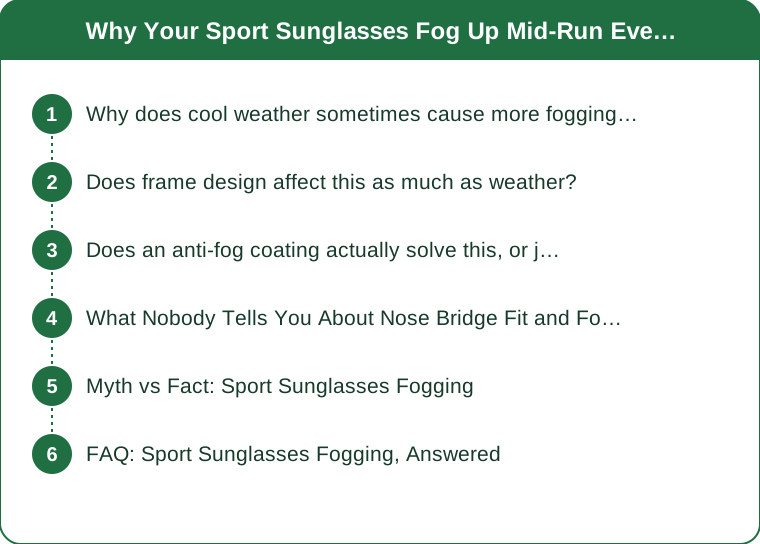
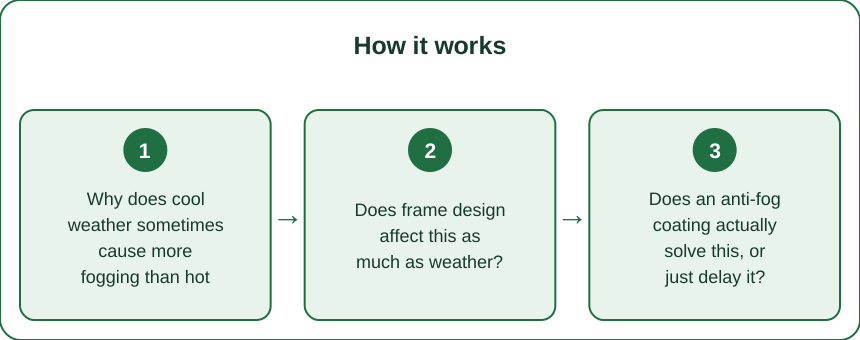
Why does cool weather sometimes cause more fogging than hot weather?
Fogging occurs when warm, moist air from your face meets a cooler lens surface and condenses. Cool, humid mornings create a bigger temperature and humidity gap between your warm face and the surrounding air than a hot, dry summer afternoon does — counterintuitively, dry heat can actually fog less than cool humidity, because there’s less moisture available to condense in dry conditions.
Does frame design affect this as much as weather?
Significantly. Frames sitting close against the face with minimal airflow trap that warm, moist air right against the lens, giving it nowhere to escape before it condenses. Frames with venting — small gaps or channels built into the lens or frame specifically for airflow — let that warm air escape rather than pool against the lens surface.
Does an anti-fog coating actually solve this, or just delay it?
It helps meaningfully by changing lens surface tension so condensation spreads into a thin, clear film rather than visible droplets, but it doesn’t stop the underlying condensation process entirely — in very high-humidity conditions combined with tight-fitting, unvented frames, coated lenses can still fog eventually, just later than uncoated ones.

What Nobody Tells You About Nose Bridge Fit and Fogging
Here’s a detail rarely mentioned: a nose bridge that sits too close to your face, common with frames sized slightly too small, traps warm breath and face heat directly against the lower lens area, causing fogging concentrated specifically at the bottom of the lens. If your fogging pattern is consistently worse at the bottom rather than even across the whole lens, an ill-fitting nose bridge — not weather — is very likely the actual cause.
Myth vs Fact: Sport Sunglasses Fogging
Myth: Fogging only happens in hot weather. Fact: Cool, humid conditions can fog lenses just as much or more than hot, dry conditions.
Myth: Anti-fog coating eliminates fogging completely. Fact: It delays and reduces fogging by changing surface tension, but doesn’t stop the underlying condensation process entirely.
Myth: Fogging is always a lens quality issue. Fact: Frame fit and ventilation often matter more than lens coating quality alone.
FAQ: Sport Sunglasses Fogging, Answered
Do ventilated frames actually look different from regular sunglasses?
Most have small visible channels or gaps near the top or sides of the lens — subtle enough that they don’t look dramatically different from standard sport frames.
Should I avoid anti-fog spray on sport sunglasses specifically?
No, it’s fine to use — apply it the same way as on any lens, to a clean, dry surface, letting it fully dry before wearing.
Does prescription insert fit affect fogging differently than direct-lens sunglasses?
Yes, prescription inserts sit slightly further from the face, which can sometimes reduce trapped warm air compared to a snug direct-lens fit, depending on the specific frame design.
TL;DR:
- Fogging is driven by the temperature/humidity gap between your face and the air, not outdoor heat directly — cool humid mornings can fog more than hot dry afternoons
- Ventilated frames let trapped warm air escape instead of pooling against the lens
- Anti-fog coating helps but doesn’t eliminate condensation entirely in high-humidity, unvented conditions
- Fogging concentrated at the bottom of the lens often points to nose bridge fit, not weather
Next foggy run, check whether it’s humidity rather than heat driving it, and look at your frame’s fit and ventilation before assuming you need a different coating.
Keep Reading
This article is for general informational and styling purposes only. Fit, sizing, and product availability may vary.