Why Wiping Your Lenses on Your Shirt Is What Actually Ruins Them
Quick Answer: Dry-wiping drags whatever dust and salt is on the lens across the surface, and technical fabrics are far more abrasive than they feel. The damage lands on the coatings - anti-reflective and hydrophobic layers only microns thick - which is why lenses go hazy and fog-prone long before they look scratched. Rinse with water first, always.
Your lenses have gone slightly milky. They fog faster than they used to and there is a haze in bright light that was not there last year.
You have never dropped them or sat on them.
What you have done is wipe them on the hem of your shirt, mid-run, a few hundred times - and that is the mechanism.

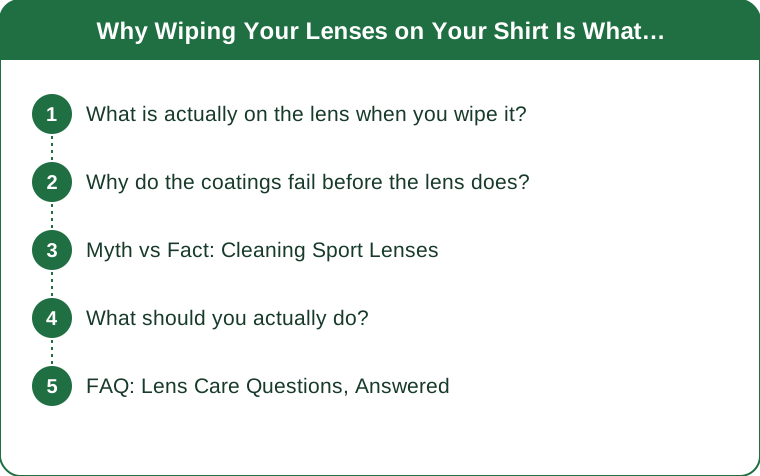
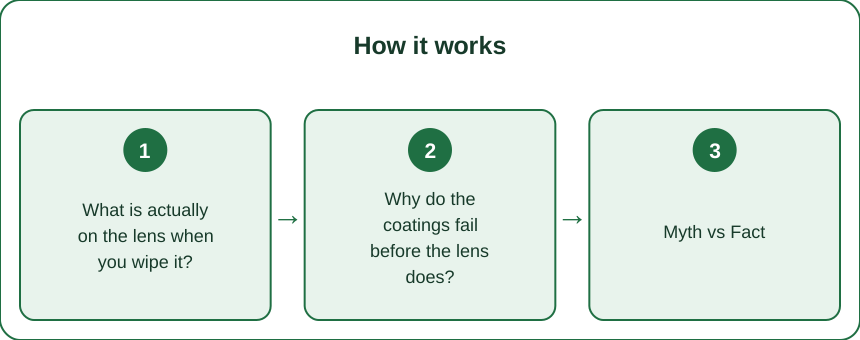
What is actually on the lens when you wipe it?
Not just moisture. That is the entire problem.
A lens after an hour outdoors carries dried sweat salt, airborne dust, pollen, and road grit. Salt crystals in particular are hard, angular, and considerably harder than a lens coating.
Wiping does not remove those particles first. It drags them across the surface under pressure. Each particle traces a line, and each line is a micro-scratch. Individually they are invisible. A few hundred of them scatter light, which is what the haze is.
And the fabric is not innocent either. Technical running fabrics feel soft against skin and are made of synthetic filaments considerably harder than a soft polymer coating. Cotton is better and still not good. A fleece is abrasive. A towel is abrasive.
So the standard mid-activity clean does two damaging things at once: it applies pressure through a moderately abrasive cloth, and it uses hard particles as the polishing compound.
The reason this is so easy to miss is that the damage is cumulative and gradual. There is no moment where the lens gets worse. It is simply better a year ago than it is now, and there is nothing to blame.
Why do the coatings fail before the lens does?
Because the coatings are the outermost layer and they are extraordinarily thin.
A modern sport lens is not just tinted plastic. It carries several functional layers: an anti-reflective coating, often a hydrophobic or oleophobic top layer, sometimes a hard coat underneath, and a mirror layer on the outside if it is a mirrored lens. Some of these are measured in fractions of a micron.
Those layers are what you paid extra for, and they are what fails first.
The hydrophobic layer goes soonest, and its loss is what people notice as the lens fogging or beading badly when it never used to. That layer works by preventing water from spreading into a film - once it is abraded away, water sheets across the lens and the lens fogs.
Anti-reflective coating damage shows as haze and as a slight loss of contrast, which is exactly what makes low autumn sun harder to look into than it used to be.
Mirror coatings are the most fragile of all and will show fine scratching from dry wiping within a season.
The base lens material itself - polycarbonate in most sport eyewear - is fairly tough and rarely the failure point. So you have a lens that is structurally fine with its useful surfaces worn off, which is a maddening way to lose a pair of sunglasses.

Myth vs Fact: Cleaning Sport Lenses
Myth: Microfibre is safe to use dry. Fact: The cloth is fine; the particles on the lens are not. A dry microfibre cloth on a salty lens does the same dragging as a shirt. Microfibre is excellent as a drying and finishing step after rinsing, which is what it is designed for.
Myth: Breathing on the lens is enough moisture. Fact: It condenses a very small amount of water, not enough to lift and float particles away, and it deposits oils from your breath. It makes the wipe slightly less damaging and does not make it safe.
Myth: Glass cleaner works fine. Fact: Many household glass cleaners contain ammonia or alcohol, both of which attack lens coatings. So do most cleaning wipes intended for screens. Water and a drop of washing-up liquid is safer than almost anything sold as a cleaner.
Myth: A scratched lens can be polished out. Fact: The polishing products sold for this remove coating rather than restore it, and on a coated lens they make the optics worse. There is no consumer fix for a scratched coated lens.
Myth: Expensive lenses are more scratch resistant. Fact: Often the opposite in practice, since they carry more coatings and more coatings means more fragile surfaces. A cheap uncoated tinted lens is remarkably durable and performs worse in every other respect.
What should you actually do?
One rule covers ninety percent of it: never touch a dry lens.
Rinse first, with any water available. Running water is ideal. A water bottle works. Even wetting the lens and letting the drops carry the particles off before you touch it is a large improvement.
Then dry with a clean microfibre cloth, gently, from the centre outward. Not in circles under pressure. The cloth is for lifting water, not for scrubbing.
Wash the cloth regularly and never with fabric softener. A microfibre cloth that has been in a pocket for six months is full of grit and is now an abrasive pad. Softener coats the fibres and destroys their ability to lift oils, which is the whole point of them.
For a proper clean, use lukewarm water and a drop of washing-up liquid, rubbing gently with fingertips, then rinse and air dry or blot with microfibre. This is what optical shops recommend and it is better than most branded sprays.
Mid-activity, when you have no water: do nothing. Live with the smear. A smeared lens for the remaining twenty minutes is a much better outcome than a permanently hazy one, and this is the habit that actually protects them.
Store them in the case, not in a bag or a pocket. Loose in a kit bag is where the deepest scratches happen, and a soft pouch is protection against dust rather than against anything hard.
And never leave them in a hot car. Heat degrades coatings and can delaminate them from the lens, and a dashboard in the sun gets far hotter than people assume.
FAQ: Lens Care Questions, Answered
Can I use lens wipes from the optician?
The pre-moistened individual sachets are generally alcohol-based, which is fine occasionally on some coatings and not recommended by all manufacturers. Check what your lens maker says, and prefer water where you have it.
How do I know if the coating has gone rather than the lens being dirty?
Wash it properly and dry it. If the haze remains after a proper clean, that is coating damage. A useful secondary test is water behaviour - if drops sheet across the lens instead of beading, the hydrophobic layer has gone.
Are replacement lenses worth it?
Often yes, and it is an underused option. Many sport frames take replacement lenses at a fraction of the cost of new glasses, and the frame is usually the part that has not worn out.
TL;DR:
- Dry wiping drags salt and grit across the lens under pressure - the particles do the cutting, not the cloth.
- The coatings fail first: the hydrophobic layer goes soonest, which is why old lenses fog when they never used to.
- Rinse with water before touching a lens, then dry gently with a clean microfibre cloth from the centre out.
- With no water available, do nothing - a smear for twenty minutes beats permanent haze.
The lenses did not wear out. They were polished with salt four times a run, and the fix is a water bottle and the discipline to leave a smear alone.
Keep Reading
This article is for general informational and styling purposes only. Fit, sizing, and product availability may vary.