Why Sport Sunglasses Feel Different Once You Add a Hat or Headband
Quick Answer: A hat or headband changes three things at once: it alters where the arms sit against your head, it redirects the airflow that keeps lenses clear, and it adds a second source of pressure at the temples. The result is glasses that slip, fog and ache in combinations they never did alone. Most of it is solved by wearing the arms outside the hat band rather than under it, and by choosing a cap with a mesh side panel.
Nothing is wrong with the glasses.
They are simply being asked to share a space they had to themselves.

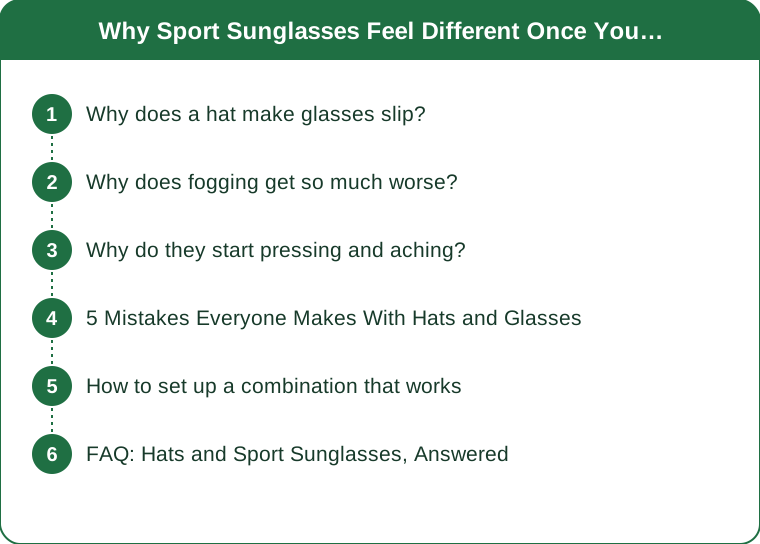
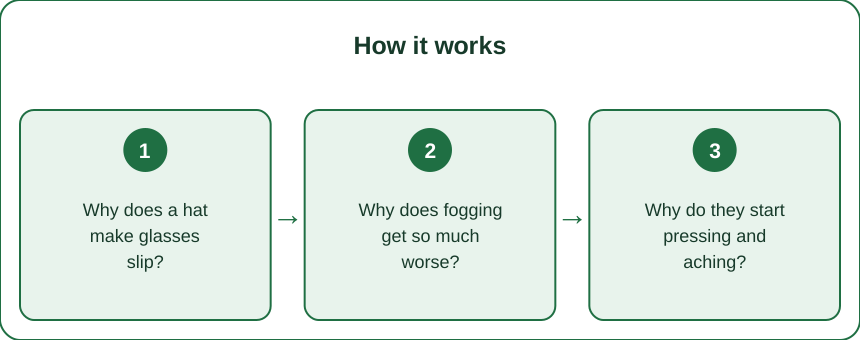
Why does a hat make glasses slip?
Because it changes what the arms are gripping.
Sport sunglasses stay on through a combination of nose pad grip and light pressure from the arms against the sides of your head, usually just above and behind the ears. That pressure is calibrated against skin and hair.
Add a cap and the arms are now pressing against fabric, and fabric is a considerably more slippery interface than skin, particularly when it is technical fabric designed to shed moisture.
Worse, a cap band is a compressible layer. Pressure that would produce firm contact against your head instead compresses the fabric, and the effective grip is reduced.
So the same glasses that held firmly now slide forward with each footfall.
There is a second effect. Cap bands sit at roughly the same height as the arms of most sport frames, which means the two are competing for the same strip of head. The cap pushes down and the arms push in, and one of them has to give.
The fix is straightforward: put the arms over the cap band rather than underneath it. This puts the arms in contact with the outside of the fabric where they can grip rather than sliding on the inside, and it takes the cap band out of the pressure equation. Most people have never tried it, and it solves the majority of slipping complaints on its own.
Why does fogging get so much worse?
Because a hat blocks the airflow that was keeping the lenses clear.
Lenses fog when warm moist air from your face meets a lens surface that is cooler than the dew point. Sport frames are designed with venting — gaps at the top of the lens, channels in the frame, and a deliberate standoff from the face — specifically to let that air move away.
A cap brim creates a pocket of still, warm, humid air directly above your eyes and in front of your forehead. A beanie or headband seals the top of the frame against fabric, closing the vents entirely.
So the ventilation system stops working exactly when you have added an extra source of trapped heat.
This is why fogging complaints spike in autumn and winter. It is not simply that the air is colder, though a colder lens does fog more readily. It is that colder weather means hats, and hats close the vents.
Practical responses:
Wear the glasses over a headband rather than under it, so the top vents stay open.
Choose a cap with mesh side panels, which restores some airflow.
Push the glasses slightly further from your face if the frame allows, using adjustable nose pads. Even a couple of millimetres of extra standoff helps.
Slow down before you stop. Fogging almost always arrives at the moment you stop moving, because the airflow that was clearing them ends. A gradual slowdown gives the lenses time.
Why do they start pressing and aching?
Because two sources of pressure are stacking at the temples.
The temples are a sensitive area with relatively little padding, and both a cap band and glasses arms apply pressure there. Individually, neither is usually a problem. Together they add up, and the resulting ache typically appears somewhere between forty minutes and an hour and a half into a session — which is why it gets attributed to the glasses rather than to the combination.
Three contributing factors:
The cap is too tight. A snug fitted cap plus glasses is the most common version of this. A cap with a slight amount of give, or an adjustable one loosened one notch, removes most of it.
The arms are under the cap band, which forces them harder against your head as the cap compresses them inward. The same fix as for slipping applies.
Frames are too narrow. A frame that was already at the limit of comfortable width has no margin to absorb an additional layer.
There is also a beanie-specific problem worth mentioning as the weather turns. A knitted beanie pulled down over the ears sits exactly where glasses arms need to be, and it presses inward continuously. Wearing the beanie slightly higher, or putting the arms outside it, both help considerably — and a beanie with a flat, thin knit at the sides is meaningfully more comfortable with glasses than a thick ribbed one.

5 Mistakes Everyone Makes With Hats and Glasses
1. Putting the arms under the hat. Almost everyone does it because it looks tidier and it is what happens naturally when you put the hat on second. It causes slipping and pressure simultaneously, and reversing the order fixes both.
2. Tightening the cap to stop the glasses moving. Backwards — a tighter cap increases the pressure stack without improving the grip, because the glasses are still sliding on fabric. Loosen the cap and move the arms outside.
3. Buying anti-fog spray instead of fixing the airflow. Anti-fog treatments genuinely work and they are overwhelmed by a blocked vent. Fix the ventilation first, then use the spray for the remaining margin.
4. Wearing a brim that is too long. A long brim traps more air and, in low autumn sun, casts shade over the lens which makes a dark tint harder to see through. A shorter brim or a visor performs better with glasses.
5. Keeping the same setup year-round. This is the one that catches people out every autumn — the cap-and-glasses combination that worked all summer changes completely when the air cools, the sun drops and the hat becomes a beanie, and people spend weeks assuming their glasses have developed a fault when the actual variable is the hat and the season.
How to set up a combination that works
Six adjustments, tested on a short run before you commit to a long one.
1. Glasses on first, arms outside the hat band. The single most effective change and it costs nothing.
2. Loosen the cap one notch from where you would wear it alone.
3. Choose a cap with mesh panels at the sides. Ventilation at the temples serves both airflow and comfort.
4. Use adjustable nose pads if the frame has them to increase the standoff from your face slightly. More gap means more airflow across the lens interior.
5. Consider a headband instead of a cap for cool-weather running. It keeps your ears warm, holds sweat back, and leaves the top of the frame completely unobstructed — which is the best fogging solution available.
6. Match the lens to the season, not just the hat. Low autumn sun sits at eye level for a large part of the morning and evening, which is a harder visual problem than overhead summer glare. A lighter category lens with good contrast enhancement usually beats a very dark one at this time of year, particularly under a brim that is already shading the lens.
And one gear note that solves it comprehensively for anyone who runs in all conditions: a frame with a retention strap or an adjustable temple grip stops relying on friction against the head at all. It looks more technical than most people want for a casual run, and it entirely removes the slipping problem.
If you get persistent headaches from wearing sunglasses, particularly with a hat, that is worth checking with an optician — frame width, prescription and pressure points all contribute, and it is not something to push through.
FAQ: Hats and Sport Sunglasses, Answered
Arms over or under the hat — is there a real consensus?
Over, for grip, comfort and ventilation. Under looks neater and performs worse on all three. The only argument for under is keeping the arms out of the wind in very cold conditions.
Why do my glasses only fog when I stop?
Because the airflow that was clearing them stops at the same moment while your face is still producing heat and moisture. Slowing down gradually rather than stopping abruptly helps a great deal, as does lifting the glasses off your nose for a few seconds.
Is a visor better than a cap?
For glasses, yes — an open top releases heat and there is no band competing with the arms. The trade-off is less warmth and no sun protection for the top of your head.
What about wearing glasses with a beanie in winter?
Arms outside the beanie, and choose a thinner flat knit at the sides. A thick ribbed beanie plus glasses is genuinely uncomfortable for most people over an hour.
Do photochromic lenses help with the brim shading problem?
Substantially, yes — they adjust to the light reaching them, so they lighten under a brim and in shade and darken in open sun. They are one of the more genuinely useful features for anyone running in variable autumn light.
My glasses slip even without a hat. Is this the same issue?
No — that is a fit problem with the frame itself. Adjustable nose pads, a different frame width, or grippier temple tips are the answers there, and adding a hat will only make it worse.
TL;DR:
- A hat changes arm grip, blocks lens ventilation and stacks pressure at the temples, all at once
- Wearing the arms outside the hat band rather than under it fixes slipping and pressure together
- Fogging spikes in autumn because hats close the frame vents, not simply because the air is colder
- Mesh-panel caps, headbands and visors all restore airflow that a solid cap removes
- Low autumn sun under a brim usually calls for a lighter lens category, not a darker one
On your next run, put the glasses on first and the cap over the top of the arms. It looks marginally less tidy and it solves most of what has been annoying you since the weather turned.
Keep Reading
This article is for general informational and styling purposes only. Fit, sizing, and product availability may vary.