Why Contact Lens Wearers Need Different Sport Frames
Quick Answer: Contact lenses depend on a stable tear film, and airflow across the eye is what destroys it. Standard sport frames with open sides and top vents deliberately move air across the eye to prevent fogging — which is exactly wrong for lens wearers. What you want instead is a wrap frame with high coverage, minimal top venting and a close fit, accepting slightly more fog risk in exchange for a stable tear film.
Twenty minutes in and your right lens has shifted. By half an hour your eyes feel gritty and you are blinking hard every few seconds.
You assume it is the lenses, or the pollen, or that you are just someone whose eyes do this.
It is frequently the frames. Sport sunglasses are designed to ventilate, and ventilation is the specific thing a contact lens cannot cope with.
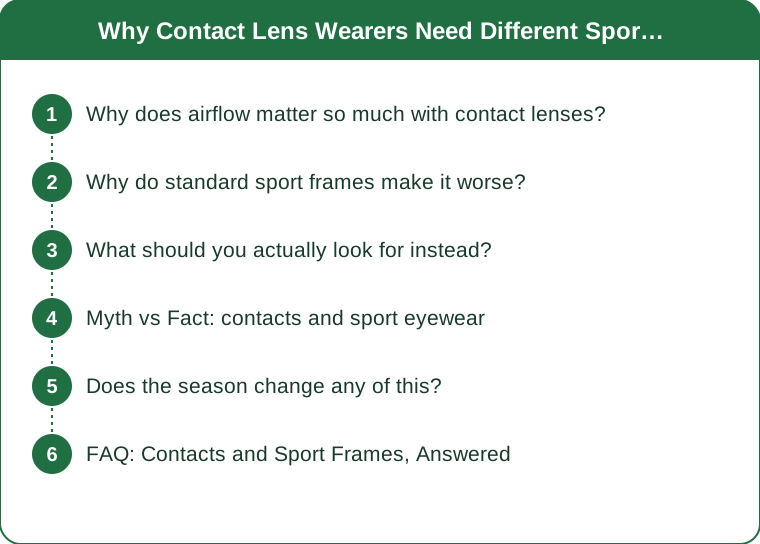
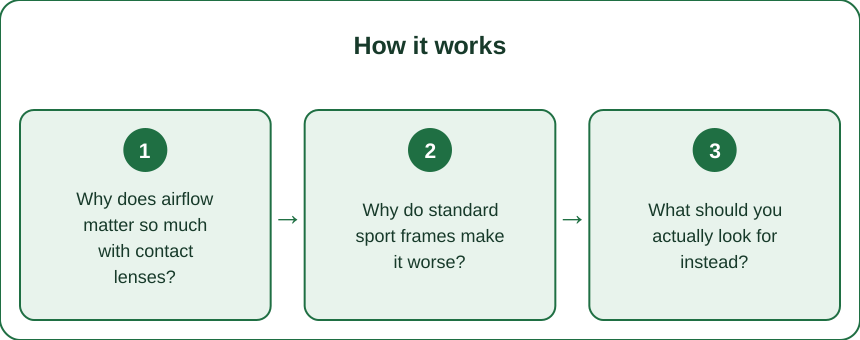
Why does airflow matter so much with contact lenses?
Because a contact lens floats on your tear film, and tear film evaporates.
Your eye is covered by a thin, layered film of tears. A soft contact lens sits on it, holds moisture within itself, and stays comfortable as long as that film is replenished by blinking.
Moving air accelerates evaporation dramatically. The same effect that dries laundry faster on a breezy day dries your eye surface faster on a run. When evaporation outpaces blinking, three things happen in sequence:
- The lens surface dries and vision goes slightly hazy — the first sign, often mistaken for sweat or dust.
- The lens loses its smooth glide on the eye and starts to grip, which is when it shifts position or folds at the edge.
- Your eye responds with reflex tearing, which feels like relief but produces watery tears that lack the stabilising components — so the cycle repeats worse.
Add exercise and it compounds. You blink significantly less when concentrating, and people blink less during effort than at rest. So exactly when the air is moving fastest, your resupply mechanism is running slowest.
Why do standard sport frames make it worse?
Because they are engineered to solve a different problem: fogging.
Fog forms when warm, humid air from your face meets a cooler lens surface. The standard solution is ventilation — brow vents along the top of the lens, gaps at the sides, and channels that deliberately draw air across the inside of the lens.
That airflow passes directly across your eyes. For a spectacle wearer or someone with no correction, it is a fair trade: clear vision, slightly breezy eyes.
For a contact lens wearer it is the wrong trade entirely. You are paying with tear film stability for a fog solution you may not need, since your lenses are not sitting in front of a contact lens fogging up in the first place.
The design features to look at critically:
- Brow vents — small slots along the top rim. Great for fog, bad for eyes.
- Open temple design — frames that stand away from the face at the sides let crosswind through.
- Small lens with a gap at the bottom — allows air from below, which is the least noticed source.
- Flat lens geometry — does not seal the eye area at all.
None of these are flaws in the frames. They are just optimised for a wearer you are not.
What should you actually look for instead?
Coverage and closeness, in that order.
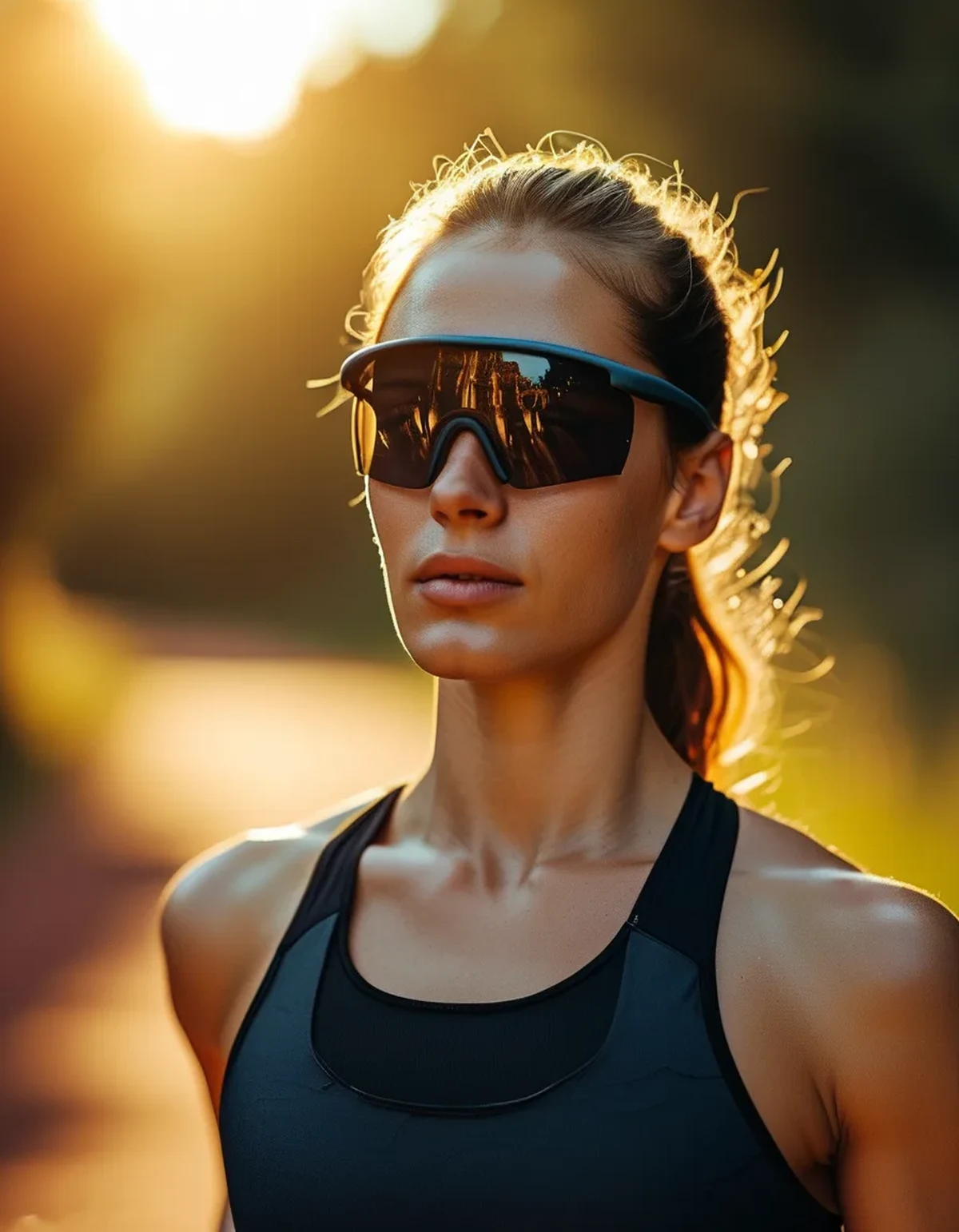
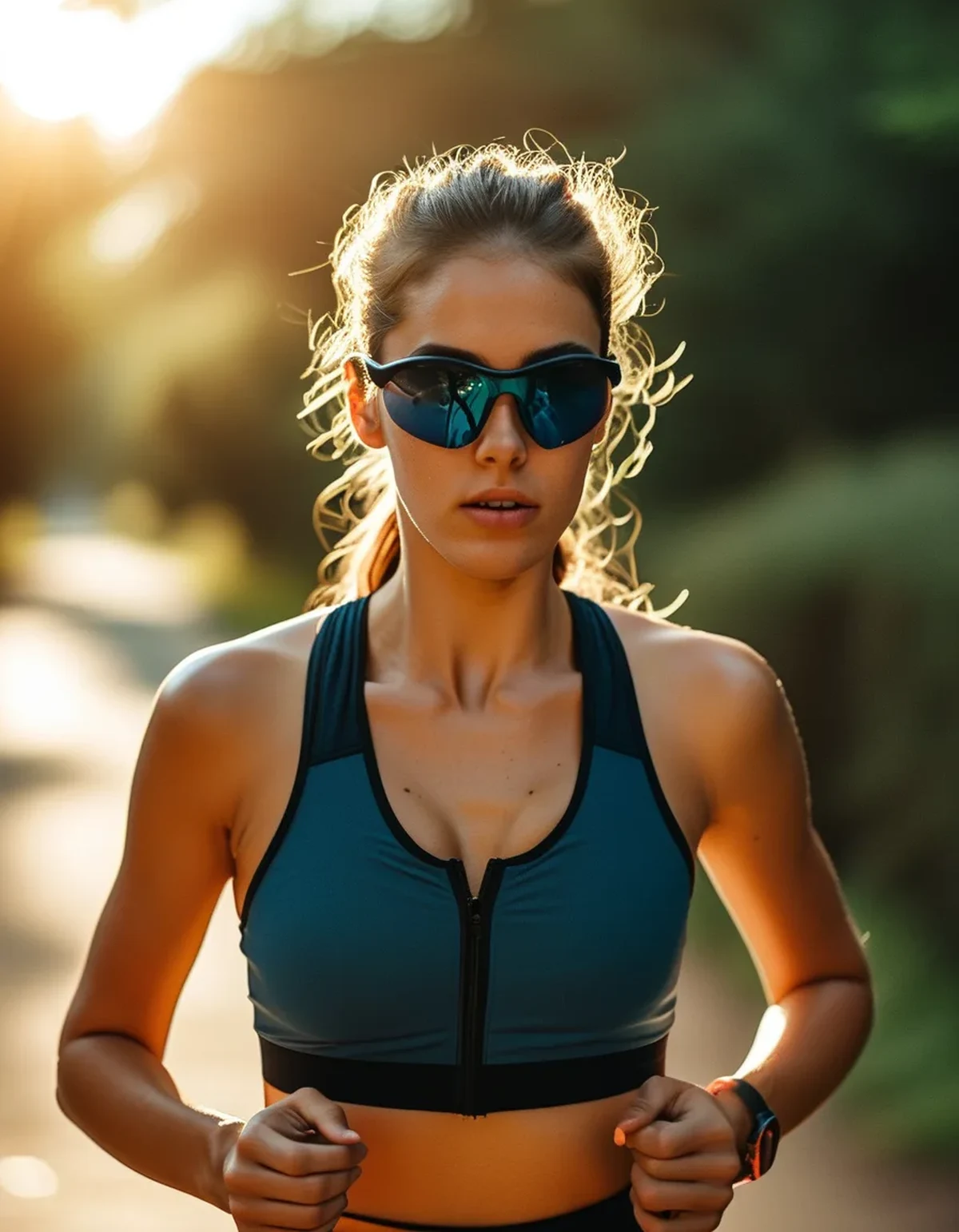
1. A genuine wrap. Base 8 or similar high-curvature lens geometry that follows the face around toward the temple. This blocks crosswind, which is the largest single source of airflow across the eye during running and cycling.
2. Minimal or no brow venting. Solid top rim. You will fog more when you stop; you will be far more comfortable when you move.
3. A close fit at the temples. Frames that hug rather than stand off. Adjustable temple tips help here.
4. Larger lens area than you think you need. Coverage below the eye matters more than most people expect — updraft from the cheeks in warm weather is a real source of drying.
5. Good nose pad grip. Nothing is worse for lens wearers than frames that slide down, because a frame sitting 5mm low opens a gap at the top and channels air straight in.
The fog trade-off is manageable. Anti-fog coating, a moment of lifting the frames off your face at stops, and simply accepting some fog when stationary. Fog when you stop is an inconvenience. Dry lenses at mile eight is the end of the session.
Myth vs Fact: contacts and sport eyewear
Myth: Daily disposables solve the drying problem. Fact: They help — a fresh lens surface each day carries fewer deposits — but airflow still evaporates the tear film beneath them. Dailies reduce the irritation load, not the drying mechanism.
Myth: Wearing sunglasses is optional if you have UV-blocking contacts. Fact: UV-blocking contacts cover the cornea, not the conjunctiva, the eyelids, or the skin around the eye. They are a supplement to sunglasses, not a replacement.
Myth: Photochromic lenses are worse for contact wearers. Fact: Unrelated. Tint technology has no bearing on airflow. Choose photochromic or not on light conditions alone.
Myth: Eye drops before a run fix it. Fact: Partly. Drops help, but plain saline washes out and lasts minutes. A contact-safe lubricating drop before and immediately after works better than either during the session, when you often cannot apply them cleanly anyway.
Myth: If your eyes water, they are not dry. Fact: This is the most misleading symptom in the whole area. Reflex watering is a dry eye response, not evidence of good lubrication — the tears produced are watery and evaporate almost immediately.
Does the season change any of this?
Considerably, and late summer into autumn is one of the harder transitions.
Warm, humid late-summer air is relatively kind to tear film — evaporation is slower when the air is already carrying moisture. Fogging is the bigger complaint in this period, which is why people buy heavily vented frames in August.
Then the air dries out. Cooler autumn air holds less moisture, wind picks up, and indoor heating starts. All three accelerate tear film evaporation. The frames that felt perfect in August become the reason your eyes are streaming in October, and almost nobody connects the two.
Low autumn sun adds a second problem. With the sun sitting lower, you get more direct glare at eye level and more squinting, and squinting further reduces effective blinking.
Practical seasonal adjustments:
- Move to a closer, less vented frame as the air dries. If you own two pairs, this is when to switch.
- Increase lubricating drops before sessions, not during.
- Consider glasses instead of contacts for windy days. Not the answer people want, but genuinely the most effective one for long efforts in cold wind.
Persistent eye discomfort, pain, or vision changes with contact lens wear should be checked by an optometrist rather than managed with equipment. This is general information, not medical advice.
FAQ: Contacts and Sport Frames, Answered
Should I switch to glasses for running instead?
For long efforts in cold wind, glasses genuinely are more comfortable. For most sessions, contacts plus the right frame works well and avoids the fog and bounce issues that prescription sport glasses bring.
Will a wrap frame with no vents fog constantly?
While you are moving, rarely — your own airflow clears it. Fogging happens when you stop, at traffic lights or on climbs. Lifting the frames onto your forehead for ten seconds clears it.
Does lens material affect how dry my eyes get during exercise?
Yes. Silicone hydrogel materials with lower water content often stay more comfortable during exercise than high-water-content lenses, which can dehydrate faster. Worth raising with your optometrist if drying is a recurring problem.
TL;DR:
- Contact lenses depend on tear film, and airflow across the eye is what destroys it.
- Standard sport frames are vented deliberately to prevent fog — the opposite of what a lens wearer needs.
- Look for a genuine wrap, solid top rim, close temple fit and large coverage, and accept some fog when stopped.
- Reflex watering is a dryness symptom, not evidence of lubrication.
- As the air dries out in autumn, switch to your closest-fitting frames rather than your most ventilated.
If you have spent a season blaming your lenses for gritty, shifting, streaming eyes on every run, borrow a proper wraparound frame for one session before you change prescriptions. It is a surprisingly common misdiagnosis, and the fix costs a pair of sunglasses rather than a trip back to the optometrist.
Keep Reading
This article is for general informational and styling purposes only. Fit, sizing, and product availability may vary.