Why Sport Sunglasses Give You a Headache After an Hour
Quick Answer: Three causes account for almost all of it: frame pressure on the temples or behind the ears, lens distortion from high-curvature wrap frames, and a tint that is too dark so you squint anyway. They feel similar and need completely different fixes. Work out which one you have by where the ache sits and when it starts. Pressure builds gradually and eases fast; distortion starts within twenty minutes and eases slowly.
The headache is telling you something specific.
The location and the timing tell you which of the three you are dealing with.

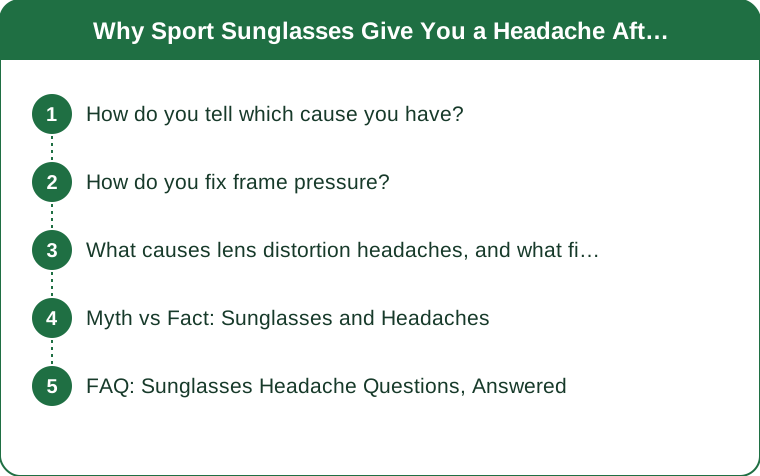
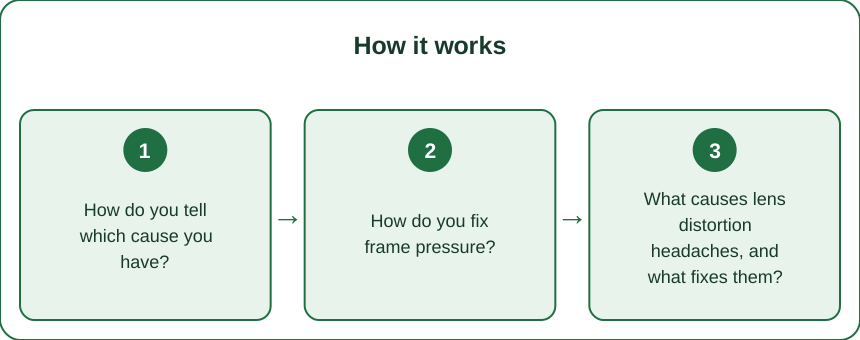
How do you tell which cause you have?
By where the pain is and how quickly it resolves after you take them off.
Frame pressure: ache at the temples or behind the ears, builds gradually, eases within ten to fifteen minutes of removal. This is a straightforward mechanical problem and the most common of the three. Look for red marks or indentations at the pressure points - they confirm it immediately.
Lens distortion: ache behind the eyes or across the forehead, often with mild nausea or a sense of things swimming at the edges of vision. It starts relatively early - typically within the first twenty to thirty minutes - and takes longer to clear afterwards. This is eye strain, and it comes from your visual system working to compensate.
Squinting strain: ache around the eyes and between the brows, worse in bright conditions, with tightness in the small muscles around the eyes. The paradox is that it happens with dark lenses more often than light ones - because a very dark tint in the wrong conditions makes you strain to see contrast rather than to block light.
Two more possibilities worth ruling out. Dehydration and clenching your jaw both produce headaches during exercise and both get blamed on the sunglasses. If it happens on the days you do not wear them too, it is not the glasses.
And check whether it is only on long sessions. A headache that only ever appears after ninety minutes is much more likely to be pressure or dehydration than optics.
How do you fix frame pressure?
Adjustment first - it is free, it takes two minutes, and it solves most cases.
Most sport frames can be adjusted. Acetate and metal frames can be widened at the temples with gentle heat by any optician, usually at no charge. Ask - almost nobody does.
Check where the frame actually touches. A well-fitted frame contacts at the nose and lightly behind the ears, and should not grip the sides of your head at all. Pressure at the temples means the frame is too narrow for your face, which no amount of adjustment elsewhere will fix.
Adjustable nose pads change the whole distribution. Widening them lowers the frame slightly and shifts weight off the temples; narrowing them raises it. A millimetre makes a noticeable difference over two hours.
Behind-the-ear pain usually means the temple arms curve too early. An optician can reshape them so the bend sits behind the ear rather than on it.
A strap changes the mechanics entirely. Converting to a retainer strap lets you loosen the frame’s grip completely, because it is no longer relying on friction to stay on. For anything high-intensity this is usually the right answer.
And weight matters more over time than at the counter. A frame that feels fine for thirty seconds in a shop can be genuinely uncomfortable at hour two. Try them on for at least five minutes before buying.

What causes lens distortion headaches, and what fixes them?
High-curvature wrap lenses that were not manufactured to correct for their own geometry.
Wrap frames curve strongly around the face, which is excellent for blocking peripheral light and wind. But a strongly curved lens changes how light reaches your eye off the optical centre, and if that is not compensated for in manufacturing, you get subtle prismatic distortion.
Your visual system works hard to compensate. That effort is invisible but real, and after twenty or thirty minutes it presents as eye strain and a headache behind the eyes. This is why the distortion headache starts earlier than the pressure one.
Quality genuinely differs here. Good sport lenses are designed with decentred optics to correct for the wrap angle. Cheap wrap lenses often are not - and this is one of the few places where price reliably predicts a real functional difference.
A quick test: look at a straight horizontal line - a door frame, a horizon - and move your head slowly side to side. If the line appears to bend or swim, the optics are the problem.
The fix is a lower base curve or better lenses. A less aggressively wrapped frame reduces the effect substantially, and many people find a moderate wrap gives most of the wind protection with none of the strain.
And prescription wearers should be especially careful. A prescription in a high-wrap frame requires specific compensated manufacturing, and a standard prescription put into a wrap frame is a reliable source of exactly this headache.
Myth vs Fact: Sunglasses and Headaches
Myth: A darker lens is always more comfortable in bright light. Fact: too dark reduces contrast and makes you strain to resolve detail, and your pupils dilate behind them. Lens category matters more than perceived darkness - a category 3 lens is right for most bright conditions, and category 4 is genuinely too dark for many activities including driving.
Myth: Polarised is always better. Fact: polarisation cuts glare from horizontal surfaces brilliantly, but it can also make some screens unreadable and can hide patches of ice or wet surfaces. For most running and cycling it is a preference, not an upgrade.
Myth: If they fit in the shop they will fit for a long run. Fact: pressure is cumulative. Comfort at minute one tells you very little about hour two, which is why five minutes of wear before buying is the minimum useful test.
Myth: Headaches mean the tint is wrong. Fact: frame pressure is more common than tint problems. Check for red marks before you buy a different lens.
Myth: Cheap and expensive lenses only differ in branding. Fact: optical quality of the lens itself varies substantially, particularly in high-wrap designs where compensation is required.
Myth: You do not need sunglasses on overcast days. Fact: a substantial amount of UV passes through cloud, and the low autumn sun sits at an angle that hits your eyes directly for much of the day. Overcast autumn mornings are one of the more demanding conditions there are.
FAQ: Sunglasses Headache Questions, Answered
Can I adjust the frame myself?
Minor nose pad adjustments, yes, carefully. Temple arm bending should be done by an optician - plastic frames need controlled heat and snap easily when cold. Most opticians adjust frames free of charge whether or not you bought them there.
Would a strap really help?
Often a lot. It lets you loosen the frame’s grip on your head entirely, since the strap holds them on instead of friction. For anyone with temple pressure during high-intensity activity, it is the cheapest effective fix available.
Should I see someone about it?
If the headache persists after you have ruled out the glasses, or if it comes with visual changes, nausea, or does not resolve after removal. A headache that is genuinely caused by eyewear resolves once the eyewear comes off - one that does not is worth an eye test or a doctor’s opinion. This is general information, not medical advice.
TL;DR:
- Three causes: frame pressure, lens distortion, and squinting through a too-dark tint. They feel similar.
- Location and timing identify it - temples and gradual is pressure; behind the eyes and early is optics.
- Frame pressure is usually adjustable for free at any optician, and a retainer strap solves most of the rest.
- Distortion comes from high-wrap lenses without compensated optics. Test with a straight horizontal line.
- Darker is not better - the wrong category makes you strain rather than relax.
Check your temples in a mirror right after your next long session. Red marks answer the question before you spend anything.
Keep Reading
This article is for general informational and styling purposes only. Fit, sizing, and product availability may vary.