Why Polarised Lenses Are the Wrong Choice for Some Sports
Quick Answer: Polarised lenses work by blocking horizontally oriented light, which removes glare from flat surfaces. That is exactly what you want on water or a road, and exactly what you do not want when the glare itself is information — reading ice, spotting wet patches on a road bike, or judging a surface. They also interfere with LCD screens and can create odd effects with some windscreens and goggles.
You bought the polarised version because it was the better one. Then you could not read your bike computer, and the road looked oddly uniform.
Polarisation is not a quality upgrade. It is a specific filter with specific consequences.
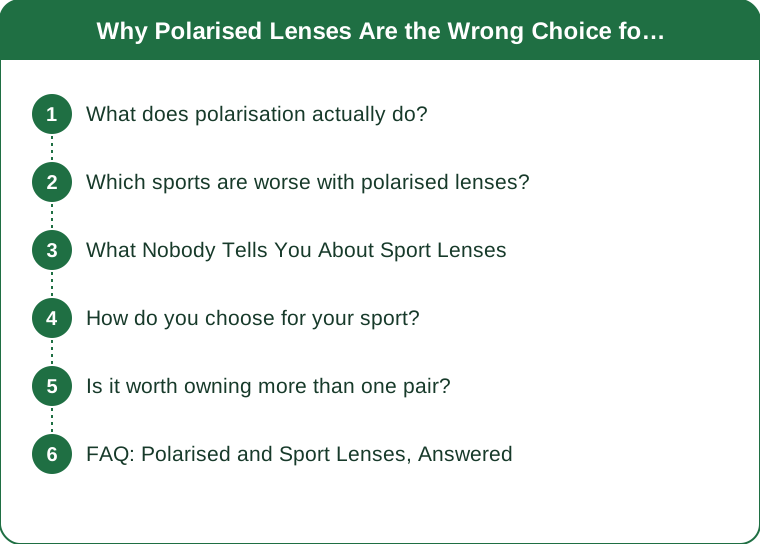
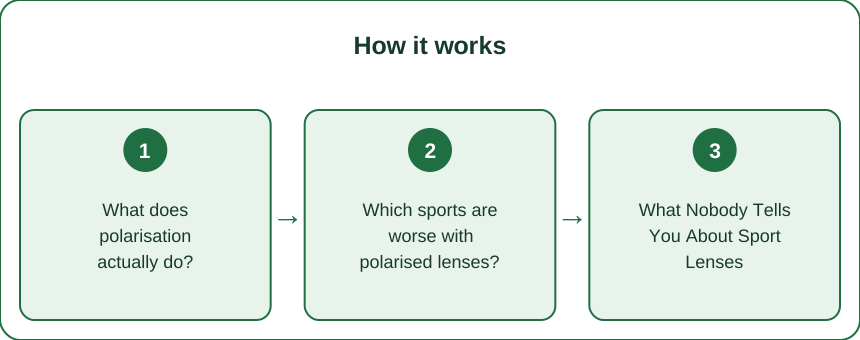
What does polarisation actually do?
It blocks light waves oscillating in one orientation.
When light reflects off a flat horizontal surface — water, a road, snow, a car bonnet — it becomes preferentially polarised in the horizontal plane. That reflected light is glare: intense, uninformative, and it swamps the detail behind it.
A polarised lens contains a filter aligned to block horizontally polarised light while passing the rest. The glare disappears; the image behind it becomes visible.
On water this is dramatic. Surface reflection vanishes and you can see into the water. For anglers and boaters it is transformative and there is no substitute.
On a road in a car it is genuinely useful — wet road glare and windscreen reflections both drop substantially.
The trade is that you lose the reflected light entirely, and there are situations where that reflection was telling you something important. A polarised lens does not dim glare; it removes it. When glare is the signal, the signal is gone.
Which sports are worse with polarised lenses?
Several, and for different reasons.
Road cycling. The reflective sheen off a wet or icy patch is often the only warning you get. Polarisation removes exactly that cue, and the road surface reads as more uniform than it is. Many experienced road cyclists deliberately use non-polarised lenses for this reason.
Skiing and snowboarding. Contested, and worth understanding. Polarisation cuts snow glare effectively, but it also flattens the distinction between icy patches and softer snow — the sheen off ice is a reflection, and removing it removes the read on the surface. In flat light it also reduces contrast where you have least to spare.
Golf. Reading a green depends partly on subtle reflection off grass, and polarisation alters that. Depth perception on undulating surfaces is also affected for some players.
Any sport with an LCD or LED display. Bike computers, GPS watches, dashboard screens and phones can appear black at certain angles through polarised lenses. Tilting your head changes it, which is workable and irritating.
Pilots and some motorsport, for the same screen reasons plus interference with cockpit glass.
Where polarisation is clearly right: fishing, sailing, kayaking, beach sports, running or cycling near water, and driving.
What Nobody Tells You About Sport Lenses
Lens category matters more than tint colour. Sunglasses are rated 0-4 for how much light they transmit. Category 3 is standard for bright conditions; category 4 is very dark and not legal for driving in many places. Most people choose by colour and never look at the category, which is the number that actually determines whether you can see.
Photochromic lenses do not darken properly behind a car windscreen, because most windscreens block the UV that triggers them. This surprises drivers who bought them specifically for varying light.
They also react slowly in the cold. Photochromic lenses take longer to change at low temperatures, which is exactly when a skier or winter cyclist moves between bright and shaded sections.
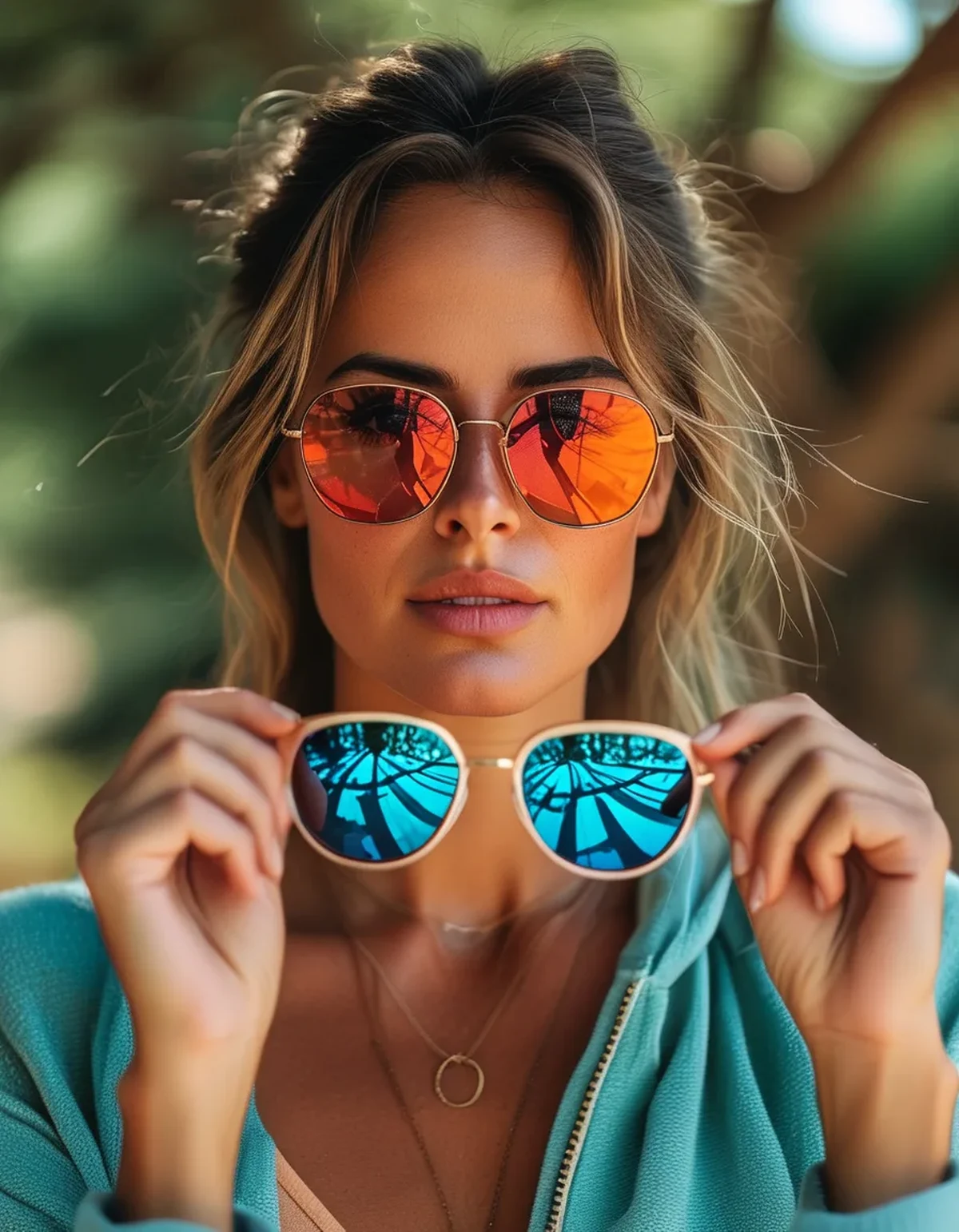
Mirror coatings reduce transmitted light without a darker tint, which is why they are common in high-glare sports. They also scratch more readily than uncoated lenses and show every mark.
Brown and amber tints increase contrast; grey tints preserve colour accuracy. For sports where reading surface texture matters, brown or rose usually outperforms grey. For anything where judging true colour matters, grey.
Fit determines performance more than the lens does. A superb lens in a frame that slips, fogs, or sits away from your face performs worse than a mediocre lens in a frame that stays put. Wrap and coverage also block peripheral light that no tint can address.
Cheap lenses that are dark but not UV-protective are genuinely harmful — dark lenses dilate your pupils and then admit more UV than no glasses at all. Any pair should state UV400 or 100% UVA/UVB, and that protection is unrelated to how dark they look.
How do you choose for your sport?
Working from the conditions rather than from the marketing.
Ask what the glare source is. If it is a flat horizontal surface and the glare carries no information — water, wet tarmac while driving — polarised. If the reflection tells you about the surface you are about to move over, non-polarised.
Ask whether you read screens. Cyclists, runners and triathletes using a device usually want non-polarised, or at least should test the specific combination before committing.
Ask about the light range. Consistent bright conditions suit a fixed category 3 lens. Highly variable conditions — trail running under tree cover, road cycling into evening — suit photochromic or an interchangeable lens system, and interchangeable is more reliable than photochromic in the cold.
Ask about contrast needs. Sports requiring you to read a surface — mountain biking, trail running, skiing, golf — benefit from contrast-enhancing brown, amber or rose tints. Sports where you track an object against the sky benefit from something that preserves contrast without darkening excessively.
Then check fit properly: shake your head vigorously, look down sharply, and check they stay put. Any sport pair should have grippy nose pads and temple tips that hold when damp, and coverage that stops light entering from the sides and above.
If you have any eye condition, or notice persistent glare sensitivity, headaches, or vision changes, get an optometrist’s advice rather than solving it with lens choice — this is general information, not medical advice.
Is it worth owning more than one pair?
For anyone doing a sport regularly outdoors, usually yes, and it need not be expensive.
The common two-pair setup: a polarised pair for water-based activity and driving, and a non-polarised contrast pair for cycling, running or snow. This covers almost every scenario and is more useful than one expensive pair attempting everything.
The alternative is one frame with interchangeable lenses, which many sport brands offer. A bright lens, a low-light lens, and sometimes a clear lens for night or heavy rain. This is generally better value than multiple complete pairs and is the standard approach among cyclists.
Do not overlook a low-light lens. Yellow, rose or clear lenses for overcast conditions and dusk are the most under-bought category. They do very little about brightness and a great deal about contrast, which is precisely what is missing in flat light, and they also protect your eyes from wind and debris.
And keep a cheap backup. Sport sunglasses get sat on, dropped and lost. A modestly priced non-polarised pair with proper UV protection in your bag means never training in bright sun without eye protection because the good pair is at home.
FAQ: Polarised and Sport Lenses, Answered
How can I tell if a pair is actually polarised?
Hold them in front of an LCD screen and rotate them 90 degrees. If the screen darkens dramatically or goes black at one orientation, they are polarised. This also works with two pairs held at right angles to each other — the overlap goes dark.
Does polarisation provide extra UV protection?
No — they are entirely separate properties. A polarised lens with poor UV filtering protects your eyes less than a clear lens with full UV400. Check the UV specification independently of any polarisation claim, since many listings imply the two are connected.
Are expensive lenses actually better optically?
Up to a point. The genuine differences are in optical clarity and distortion, coating durability, and impact resistance — polycarbonate and Trivex lenses are far more impact-resistant than standard plastic, which matters in any sport where something could hit your face. Beyond a moderate price point the returns come mostly in frame quality and lens options rather than in the lens itself.
TL;DR:
- Polarisation blocks horizontally reflected light, which removes glare — and removes surface information along with it.
- Wrong for road cycling (ice and wet patches read as sheen), often wrong for skiing and golf, and problematic with any LCD display.
- Right for fishing, sailing, kayaking, beach sports and driving, where the glare carries nothing you need.
- Lens category (0-4) determines how much light gets through and matters more than tint colour; brown and amber boost contrast, grey preserves colour.
- UV protection is independent of darkness and of polarisation — dark lenses without UV filtering are worse than none.
The reason polarisation gets oversold is that its benefit is instantly visible in a shop and its cost is invisible until you are on a wet road at speed. It is a specialised filter that happens to be excellent in a handful of situations, and treating it as the premium option rather than as a specific tool is how people end up unable to read their bike computer.
Keep Reading
This article is for general informational and styling purposes only. Fit, sizing, and product availability may vary.