What Lens to Wear When Your Run Starts Before Sunrise
Quick Answer: Before sunrise you need eye protection without light reduction, which means a clear or very light lens in category 0 or 1. Dark category 3 lenses in low light dilate the pupil and genuinely reduce your ability to see obstacles. The most useful low-light lens for running is a light rose, amber or yellow tint, which adds contrast against grey surfaces without meaningfully cutting brightness, and any lens you wear at dawn must have real wind and debris protection.
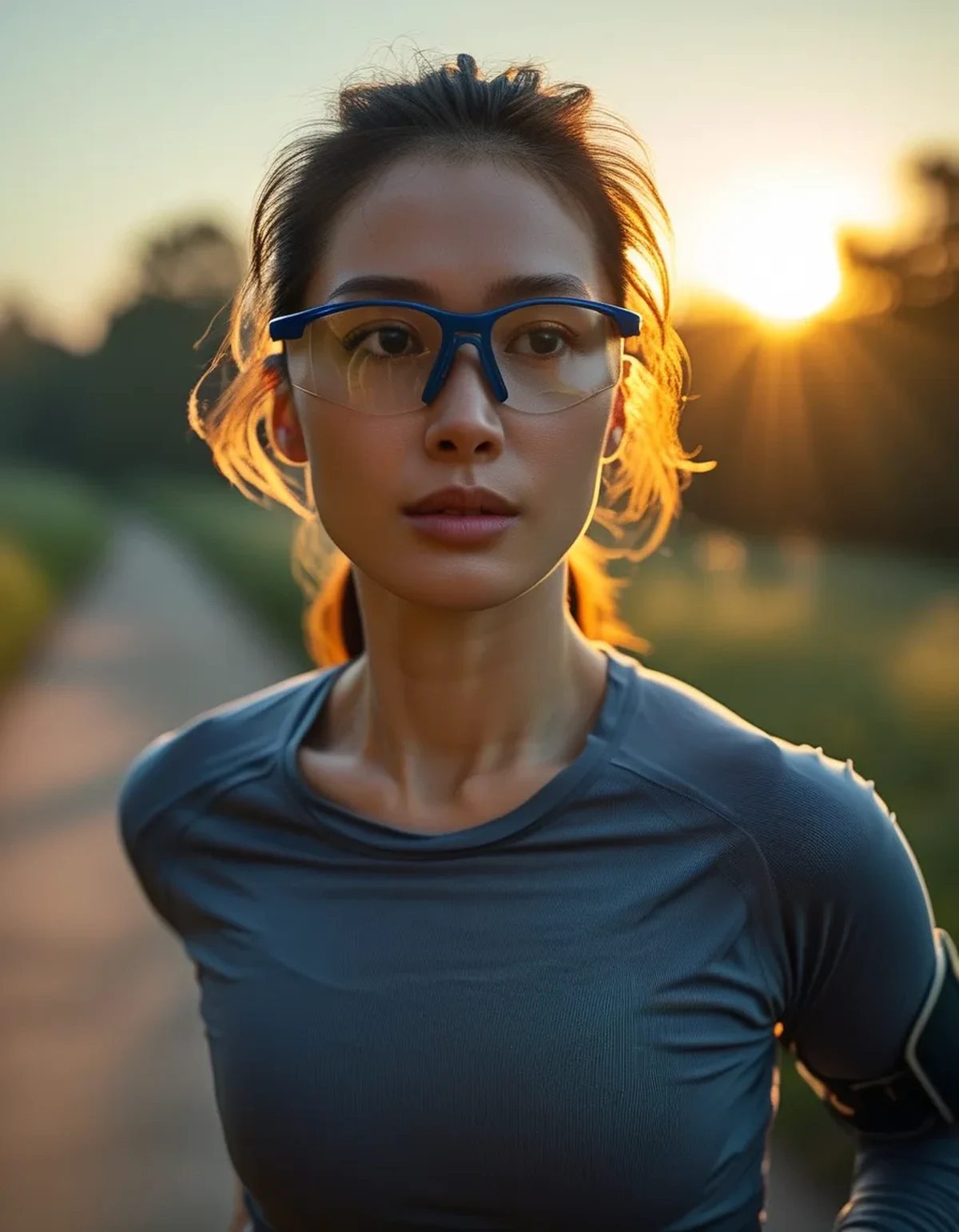
The protection you need at 6.30am is from wind, grit and branches, not from the sun.
This blog has covered why lens category matters more than colour, why low autumn sun is harder on your eyes than summer glare, and whether you need sunglasses on a cloudy day. This is the other end of the same problem.
What does lens category actually mean?
It is the only number that matters for whether a lens is safe in a given light level, and it is not the same thing as tint colour.
Lens category runs from 0 to 4 and describes how much visible light the lens transmits, independent of what colour it appears.
Category 0 transmits roughly 80 to 100 percent — essentially clear. This is the correct category for pre-dawn, night, and heavy overcast.
Category 1 transmits around 43 to 80 percent and is the practical low-light choice: enough tint to add contrast, not enough to compromise dark adaptation.
Category 2 sits around 18 to 43 percent and suits variable and overcast daylight.
Category 3, roughly 8 to 18 percent, is the standard sunglasses category and is what almost everyone owns. In pre-dawn light it is genuinely unsafe for spotting kerbs, roots and potholes.
Category 4 transmits under 8 percent and is for high mountain and glacier conditions. It is not legal for driving in many countries and has no place on a road run.
A dark-looking lens is not necessarily a high category and vice versa, which is why buying by appearance is unreliable. The category is marked on the lens or the packaging, and it is the number to check.
Why does a dark lens make low light genuinely worse?
Because it works against your eye’s own adaptation rather than alongside it.
Your pupil dilates in low light to admit more of what little there is. A dark lens forces further dilation, and there is a limit past which no more light is available.
Contrast sensitivity falls with light level, and it is contrast, not brightness, that lets you see a kerb edge or a root against a dark path.
Depth perception degrades in low light too, which matters most on uneven ground.
Dark lenses also reduce your peripheral awareness of vehicles, which is the specific risk on a pre-dawn road run.
And the transition problem is real. Running from a dark park into a lit street with a category 3 lens produces a period of poor vision in both conditions.
Photochromic lenses solve part of this but not all: most take 30 to 60 seconds to lighten and rarely reach true category 0 at their lightest, so they are excellent for changing daylight and mediocre for genuine pre-dawn.

Myth vs Fact: Low-Light Running Lenses
Myth: You do not need eyewear before sunrise. Fact: The main risks at dawn are wind-driven grit, insects, low branches on trail, and cold air causing watering. All of those are worse in autumn, not better, and a clear lens addresses them without costing you any light.
Myth: Yellow lenses make you see better in the dark. Fact: They increase perceived contrast against blue-grey backgrounds, which is genuinely useful at dawn and on overcast trails. But they transmit less total light than clear, so they do not help in true darkness — the effect is perceptual contrast, not extra light.
Myth: Any sunglasses are better than nothing on a dark morning. Fact: A category 3 lens in pre-dawn light measurably reduces your ability to see hazards. Nothing is genuinely better than dark lenses there; clear is better than both.
Myth: Photochromic lenses cover every condition. Fact: They are excellent for varying daylight but transition takes 30 to 60 seconds and most do not go fully clear. For a run that starts in the dark and ends in sunlight they are a reasonable compromise; for a run entirely before dawn they are not the best choice.
Myth: Polarised is always better. Fact: Polarisation cuts glare off wet roads well, but it can make some screens and icy patches harder to read, and it has no benefit at all in low light. It is a daylight feature.
Myth: You can just wear your everyday glasses. Fact: Street eyewear has no wraparound coverage, so wind gets in from the sides, and lenses are not made from impact-resistant polycarbonate. Wind protection is most of the reason to wear anything at dawn.
What to actually buy and use
One or two lenses cover almost everything a runner encounters.
Get a clear or very light lens, category 0 or 1, in a wraparound sport frame. This is the pre-dawn, night and heavy-overcast lens.
A light rose or amber tint is the best all-round low-light choice. It lifts contrast against grey pavement and wet leaves without meaningfully darkening the scene.
Prioritise wind coverage over optics for dawn use. A frame that seals reasonably at the sides stops the watering and grit that are the actual problem.
Make sure the lens has an anti-fog coating and some venting. Cold air plus a warm face plus low pace is the worst possible fogging combination, and dawn autumn runs hit all three.
Consider an interchangeable-lens frame if you run across a wide range of conditions. One frame plus a clear and a category 3 lens covers the year for most people.
Check the category marking before you buy, since tint appearance is a poor guide.
And wear something reflective regardless. Eyewear helps you see; it does nothing to help drivers see you, and that is the larger risk on dark mornings.
FAQ: Low-Light Eyewear Questions, Answered
Should I wear glasses for a run before sunrise?
Yes, but clear ones. The protection you need at dawn is from wind, grit, insects and branches, not from the sun. A category 0 or 1 lens in a wraparound sport frame gives you that without reducing the light you need to see hazards.
Are yellow lenses better for low light?
They increase perceived contrast against grey and blue backgrounds, which helps at dawn and on overcast trails. They do not add light, so in true darkness a clear lens is better. Treat yellow and rose as contrast tools for dim daylight, not as night vision.
Do photochromic lenses work for early morning runs?
Partly. They handle a run that starts dim and ends bright well, but they take 30 to 60 seconds to transition and most do not become fully clear. For a run entirely before sunrise, a dedicated clear lens is the better option.
TL;DR:
- Lens category, not tint colour, tells you whether a lens is safe in a given light level. Check the number, not the look.
- Category 3 sunglasses in pre-dawn light genuinely reduce your ability to see kerbs, roots and vehicles.
- Clear (category 0) or a light rose/amber (category 1) in a wraparound frame is the dawn setup. Anti-fog coating matters more than optics.
- Photochromics are a daylight-variation tool, not a pre-dawn one. And none of this makes you visible — wear reflective kit too.
As mornings darken, swap the lens rather than abandoning the glasses. Wind and grit do not take the winter off.
Keep Reading
This article is for general informational and styling purposes only. Fit, sizing, and product availability may vary.