Why Your Running Sunglasses Fog Up No Matter What You Try
Quick Answer: Fogging happens when warm, humid breath and sweat vapor get trapped against the lens without enough airflow to clear it — sunglasses with actual ventilation channels or vents, combined with an anti-fog coating, solve this far more reliably than wiping the lens mid-run.
You wipe the lenses, they clear for thirty seconds, then fog right back up. Wiping treats the symptom, not the actual airflow problem.
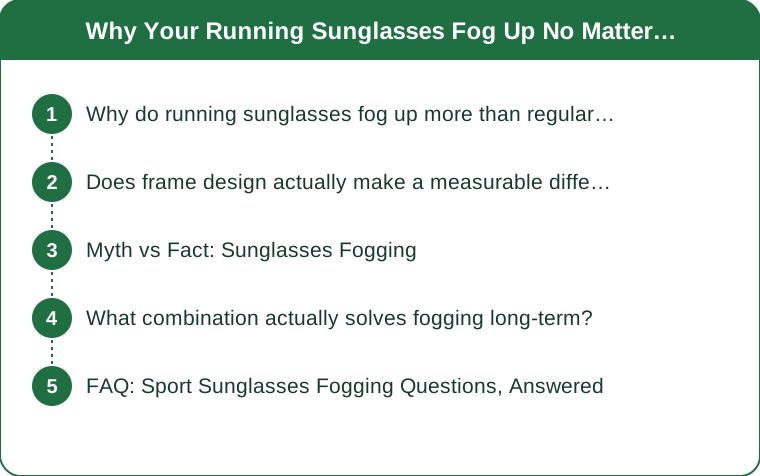
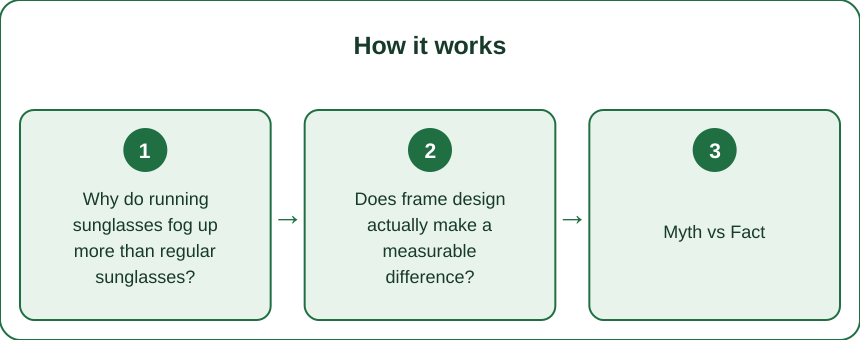
Why do running sunglasses fog up more than regular sunglasses?
Running generates significantly more body heat and heavier breathing than walking or casual wear, creating more warm, moisture-laden air near your face that condenses on a cooler lens surface. Regular sunglasses aren’t designed with this level of heat and moisture output in mind, which is why fogging is a much more common complaint specifically for running or high-intensity sport use.
Humid conditions and cold mornings (where the temperature gap between your face and the outside air is largest) make fogging worse, since condensation forms fastest when there’s a significant temperature difference across the lens.
Does frame design actually make a measurable difference?
Yes, significantly — frames with dedicated ventilation channels or gaps between the lens and your brow allow warm, moist air to escape rather than getting trapped against the lens surface. A snug, fully sealed frame that looks sleek can actually trap more heat and moisture than a slightly looser, vented design, even though the sealed style might seem like it would perform better.
Checking for visible vent gaps or perforations before buying, rather than judging purely on how snug or streamlined the frame looks, predicts fogging performance better than style alone.

Myth vs Fact: Sunglasses Fogging
Myth: “Wiping the lens mid-run permanently clears fogging.” Fact: wiping only clears existing condensation temporarily — without addressing airflow, it fogs right back up within minutes as new moisture accumulates.
Myth: “Anti-fog spray is a permanent fix.” Fact: most anti-fog sprays wear off within a workout or two and need reapplication — they help, but aren’t a one-time solution.
Myth: “All polarized lenses fog the same amount.” Fact: lens coating and frame ventilation matter far more for fogging than whether a lens is polarized — polarization affects glare, not fog.
What combination actually solves fogging long-term?
A vented frame design plus a genuine anti-fog lens coating (not just a spray, but a factory-applied hydrophilic coating) addresses both the airflow and the condensation-resistance side of the problem simultaneously, which is more effective than either fix alone. Sunglasses marketed specifically for running or cycling (rather than general lifestyle sport sunglasses) are far more likely to include both features by design.
For existing sunglasses without a factory coating, a quality anti-fog spray reapplied every few workouts, combined with actively seeking out routes or timing that avoid the coldest, most humid conditions when fogging is worst, is a reasonable middle-ground fix.
FAQ: Sport Sunglasses Fogging Questions, Answered
Do more expensive sunglasses automatically fog less?
Not necessarily on price alone — specifically check for vented frame design and an anti-fog coating rather than assuming a higher price guarantees either feature.
Does fogging mean my sunglasses are lower quality?
No — even well-made sunglasses fog if they lack ventilation, since fogging is primarily a physics and design issue, not a general quality indicator.
How often does anti-fog spray need to be reapplied?
Most sprays last a workout or two before losing effectiveness; reapplying every few sessions maintains consistent performance.
TL;DR:
- Fogging comes from trapped warm, humid air condensing on a cooler lens
- Vented frames let moist air escape instead of trapping it against the lens
- Wiping mid-run only clears fog temporarily, not permanently
- A factory anti-fog coating combined with a vented frame is the most reliable fix
Check your current pair for actual vent gaps — if there aren’t any, that’s likely doing more to cause the fogging than anything about the lens itself.
Keep Reading
This article is for general informational and styling purposes only. Fit, sizing, and product availability may vary.