Interchangeable Lens Sunglasses: How Many Lenses Do You Actually Need?
Quick Answer: Most people only regularly use 2 lenses from a kit: one dark tint for bright sun and one lighter or clear lens for low light or overcast conditions. Kits with 4-5+ lenses often sell versatility you’ll rarely use in practice — buy based on your actual conditions, not the biggest kit available.
Interchangeable lens systems get marketed around flexibility, and the flexibility is real — but most buyers end up using a fraction of what’s in the box, which makes it worth thinking about your actual conditions before paying for a five-lens kit.

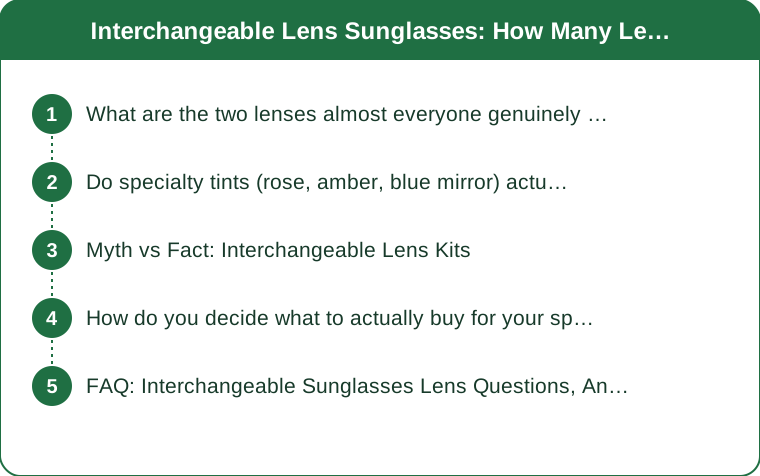
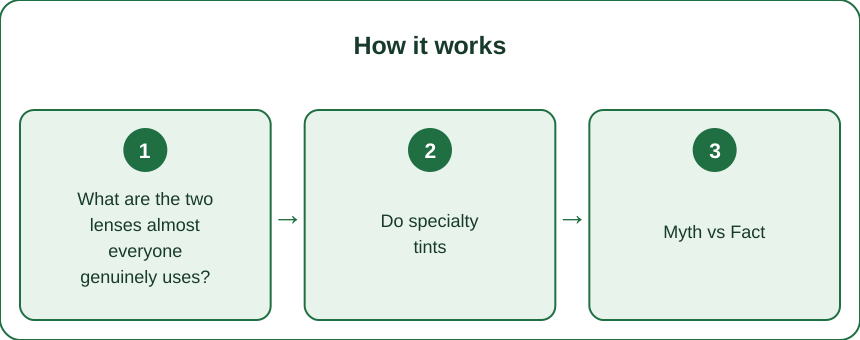
What are the two lenses almost everyone genuinely uses?
A dark, high-protection tint (often smoke, grey, or a mirrored dark lens) for bright, sunny conditions, and a light or clear/yellow lens for overcast days, dawn or dusk activity, or low-light indoor-adjacent settings. Together, these two cover the vast majority of real-world lighting conditions most people actually train or compete in.
If you only buy one extra lens beyond whatever ships as default on the sunglasses, a light-condition lens is usually the more useful addition, since dark lenses tend to already be the default option included on the frame.
Do specialty tints (rose, amber, blue mirror) actually serve a real purpose?
Some do, for specific conditions — amber and rose tints genuinely improve contrast perception against green backgrounds, which is why they’re popular for golf, trail running, and cycling on varied terrain. Blue mirror coatings mainly reduce glare intensity on very bright days and add a cosmetic element, but functionally overlap significantly with a standard dark tint for most people.
If your sport involves picking out contrast against grass, dirt, or trail terrain specifically, a contrast-enhancing tint earns its spot. If you’re mostly running on roads or in a gym, the functional benefit is much smaller.

Myth vs Fact: Interchangeable Lens Kits
Myth: More lenses in a kit always means better value. Fact: Value depends entirely on whether you’ll actually use each lens — a 5-lens kit you use 2 lenses from isn’t better value than a 2-lens kit priced accordingly.
Myth: Photochromic lenses (auto-darkening) make interchangeable systems pointless. Fact: Photochromic lenses cover a good middle range automatically but usually don’t reach the extremes (very dark for intense sun, very light for near-dark conditions) that dedicated interchangeable lenses cover.
Myth: Specialty tints are mostly marketing with no functional difference. Fact: Contrast-enhancing tints for specific terrain (amber, rose) have a real, measurable effect on object visibility against certain backgrounds — it’s not purely cosmetic, even if it’s less impactful for road-based activities.
How do you decide what to actually buy for your specific activity?
Start with your most common condition — if you mostly train in full sun, a quality dark lens is your priority purchase, with a lighter lens as the sensible second addition for occasional overcast days. If your sport involves varied terrain with grass or dirt backgrounds (trail running, golf, mountain biking), a contrast tint is worth adding as your third lens before reaching for a fourth or fifth specialty option.
Skip buying a full 5-lens kit upfront if you’re new to the sport — start with 2 lenses covering your most common conditions, and add a specialty tint later once you know it’s genuinely something you need rather than something that sounded useful in the store.
FAQ: Interchangeable Sunglasses Lens Questions, Answered
Are photochromic lenses better than a full interchangeable kit?
They’re more convenient for people who don’t want to swap lenses manually, though they typically don’t reach the same extreme light or dark range as dedicated lenses — it’s a tradeoff between convenience and range.
How often do people actually swap lenses in real use?
Honestly, less often than the marketing suggests — most people settle into using one or two lenses as their default and rarely rotate through a full kit regularly.
Is it worth buying extra lenses separately later instead of a full kit upfront?
Often yes — buying your core 2 lenses first and adding a specialty tint later once you know your actual needs usually costs less than an unused 5-lens kit.
TL;DR:
- Most people only regularly use a dark lens and a light lens from any kit
- Contrast tints (amber, rose) have real functional value specifically for grass and trail terrain
- Bigger kits aren’t automatically better value if you won’t use every lens
- Start with 2 core lenses and add specialty tints only once you know you need them
Buy for the conditions you’re actually in most often, not the full spectrum the kit advertises on the box.
Keep Reading
This article is for general informational and styling purposes only. Fit, sizing, and product availability may vary.