Do You Need Different Sunglasses for Cycling Than for Running?
Quick Answer: Yes, usually — because the head angle, airflow, and impact risk are genuinely different. Cycling needs larger coverage, a more wraparound shape, and a lens positioned for a head tilted down and eyes looking up. Running needs lighter weight, better grip against sweat and bounce, and much more ventilation because you generate more heat with less airflow. One pair can cover both if you prioritize fit, but you will be compromising on something.
Most people buy one pair of sport sunglasses and use them for everything. It usually works acceptably for one sport and slightly badly for the other, and it is worth knowing which is which.
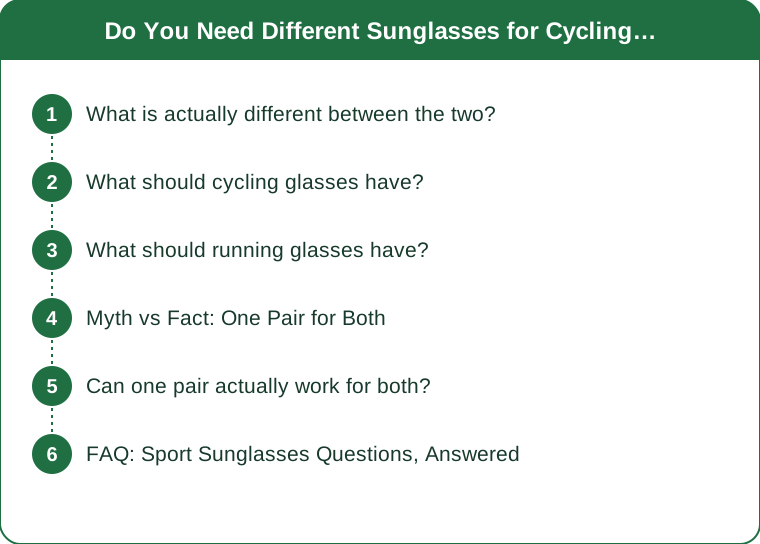
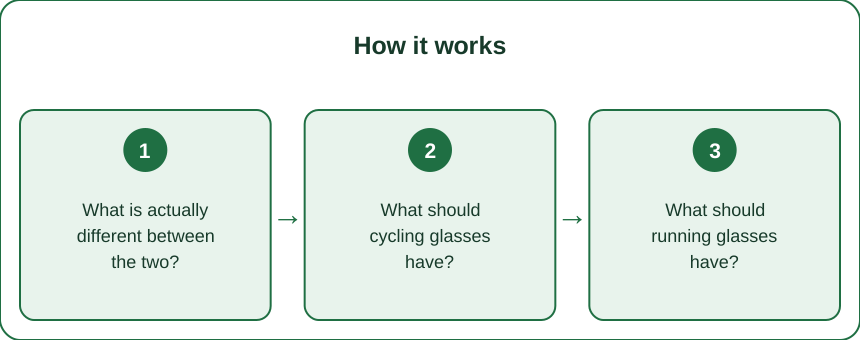
What is actually different between the two?
Head position, airflow, and what you need to see.
Head angle is the big one. On a bike, particularly in any forward position, your head is tilted down and your eyes are looking up through the top portion of the lens. A lens that sits correctly for a runner’s upright head leaves a cyclist looking over the top of the frame at the road ahead. This is why cycling glasses have such tall lenses and such a distinctive shape — it is functional, not fashion.
Airflow is completely different. A cyclist at 15 mph has constant strong airflow across the face, which keeps lenses clear but also dries eyes and drives debris in. A runner at 6 mph has very little airflow and generates more heat per unit of speed, which is why running sunglasses fog and cycling sunglasses rarely do.
Impact risk differs. Cycling has genuine debris exposure — grit, insects, road spray, and the occasional stone — and a real crash risk. Impact-rated lenses matter meaningfully more on a bike.
Movement pattern differs. Running is vertically bouncy, so glasses slide down the nose repeatedly. Cycling is relatively smooth, so grip matters less but wind lift matters more.
And what you need to see differs. A cyclist scans far ahead and needs to read road surface at speed. A runner looks a few strides ahead and needs to see footing, especially on trails.
What should cycling glasses have?
Coverage, height, and a shape built for a tilted head.
A tall lens. This is the defining feature. You need lens above your natural sightline because your head is down. The oversized single-lens shields that look extreme have that shape for exactly this reason, and once you have ridden in one you understand it.
Genuine wraparound coverage. Wind, grit, and insects come from the sides at speed. A flat-fronted frame lets all of it in, and dry eyes on a long ride are both uncomfortable and a real visibility problem.
Impact-rated lenses. Look for ANSI Z87.1 or EN 166 markings if debris protection matters to you. Polycarbonate is standard and appropriate — it is the material that does not shatter.
Grip at the temples rather than the nose. Cycling glasses are more often lost to wind lift and helmet interaction than to sliding, so temple grip and compatibility with a helmet’s retention system matter.
Ventilation at the top of the lens to handle the moments you are stopped, since that is when a cycling lens fogs.
Lens category over lens color. Category 3 is the standard bright-conditions choice. Category 4 is genuinely too dark for road cycling and is not legal for driving in many places for good reason — you need to read shadowed road surface.
And a clear or low-tint option for early starts, which matters more each week now that sunrise is getting later.
What should running glasses have?
Light weight, sweat grip, and ventilation.
Low weight above almost everything. You feel a heavy frame on your nose after 40 minutes of vertical bounce in a way you never do on a bike. Under 30 grams is a reasonable target.
Grippy nose pads and temple tips, ideally hydrophilic rubber — the kind that grips better when wet. This is the single most useful feature in a running sunglass, because sweat is the reason glasses slide, and it is a solved problem in good ones.
Real ventilation. Vents at the top of the lens, a slight gap at the brow, and a frame that does not seal against your face. Runners fog glasses far more than cyclists do because heat production is high and airflow is low, and it gets dramatically worse the moment you stop at a light.
Less wrap than a cycling pair. Some wrap is good for peripheral coverage, and a tightly sealed wraparound traps heat against your face and fogs immediately at running speeds.
A shape that suits an upright head. You are looking straight ahead, so lens height matters much less and the frame can be smaller and lighter.
Compatibility with a hat or visor, since many runners wear one and a thick temple arm conflicts with it.
And for early morning and evening runs, a lighter lens category. Category 2 or an interchangeable clear lens covers the low-light conditions that are arriving quickly at both ends of the day now.
Myth vs Fact: One Pair for Both
Myth: Sport sunglasses are all basically the same underneath the branding. Fact: Lens geometry, ventilation design, and grip material differ substantially and for specific reasons. The tall wraparound cycling shield and the light vented running frame are solving genuinely different problems.
Myth: Polarized lenses are always better. Fact: Polarization cuts glare from flat surfaces beautifully, which is excellent for water and open road. It also makes it harder to read texture on wet or shiny road surfaces and can interfere with reading a bike computer or watch screen. Many serious cyclists deliberately avoid polarized lenses; many runners love them. It is a genuine preference, not an upgrade.
Myth: Darker lenses protect your eyes better. Fact: UV protection comes from a coating and is unrelated to tint darkness. A clear lens can offer full UV protection and a very dark lens can offer none if it is poorly made. Darker lenses also dilate your pupils, so a dark lens without proper UV filtering is worse than no sunglasses at all. Check for UV400 or 100% UVA/UVB, always.
Myth: You need sunglasses only on sunny days. Fact: UV passes through cloud substantially, and glare on an overcast day can be genuinely tiring. There is also the mechanical argument — glasses keep wind, dust, pollen, and insects out of your eyes, which matters year round and matters more in late summer when pollen counts are high.
Myth: Interchangeable lens systems solve everything. Fact: They solve the tint problem well and do nothing about frame shape, weight, or ventilation. If your issue is that your cycling glasses fog when you run, a different lens will not change that.
Can one pair actually work for both?
Yes, with a clear-eyed view of what you are giving up. Here is how to choose it.
Prioritize the running requirements and accept less coverage on the bike. This is the right direction for most people, because a heavy, hot frame makes running genuinely unpleasant while a slightly small lens on the bike is merely suboptimal.
Look for: a medium-wrap frame, light weight, good ventilation, hydrophilic grips, and interchangeable lenses so you can handle both bright afternoons and dark mornings.
Check the lens height while actually in position. Put them on, tilt your head down as if riding, and look up. If you are looking over the frame, they will not work on a bike — that is the one deal-breaker.
Choose Category 3 as the main lens and add a clear or Category 1 for low light. That combination covers far more of your actual training hours than a second dark lens would.
Where the compromise costs you most: long fast road rides in windy conditions, where the lack of wrap dries your eyes; and hot humid runs where a cycling-oriented frame fogs at every stop.
Where it barely matters: casual riding, trail running at moderate pace, and any session under about forty minutes.
One thing not to compromise on either way: fit. Sunglasses that slide, pinch, or leave a gap at your temple will not get worn, and eyewear you do not wear provides no protection at all. Try them on with your actual helmet or hat, move your head around properly, and be honest about whether they stay put.
FAQ: Sport Sunglasses Questions, Answered
Do I need sunglasses for early morning runs?
For UV, not really before sunrise. For wind, insects, and dust, yes — and a clear or very light lens does that job without darkening anything. Low sun right at sunrise is also genuinely difficult to look into, and that gets worse through autumn as the sun tracks lower across the sky.
Why do my glasses fog the second I stop?
Because the airflow that was carrying moisture away disappears while your face is still producing heat and sweat. This is normal physics rather than a defect. Frames with brow vents handle it much better, and lifting the glasses off your nose for a few seconds clears them faster than anything else.
Are cheap sport sunglasses fine?
For UV protection, often yes — a certified inexpensive pair blocks UV as well as a premium one. What you pay more for is optical clarity at the lens edges, fit engineering, grip that works when wet, and impact rating. For a runner, grip and weight are worth real money. For a cyclist, impact rating genuinely is.
TL;DR:
- Cycling needs a tall wraparound lens because your head is down and your eyes look up through the top
- Running needs light weight, hydrophilic grips, and real ventilation because you make more heat with less airflow
- Impact rating matters much more on a bike; sweat grip matters much more on foot
- If buying one pair, prioritize the running requirements and check lens height with your head tilted down
- UV protection is a coating, not a tint — check for UV400 regardless of how dark they look
The test that decides it takes five seconds in the shop: put them on, drop your chin, look up. If you are looking over the frame, they are running glasses, whatever the label says.
Keep Reading
This article is for general informational and styling purposes only. Fit, sizing, and product availability may vary.